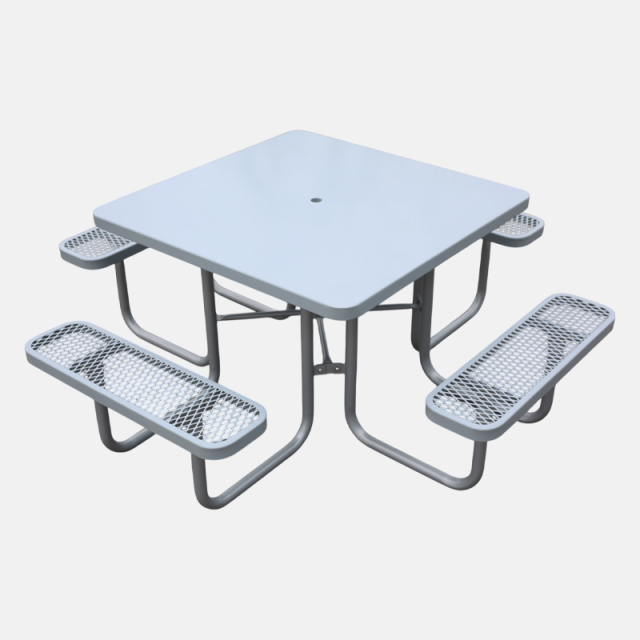
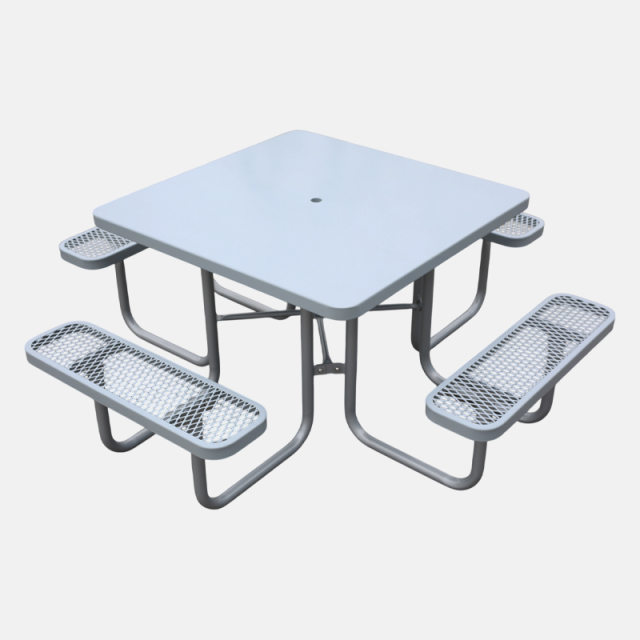
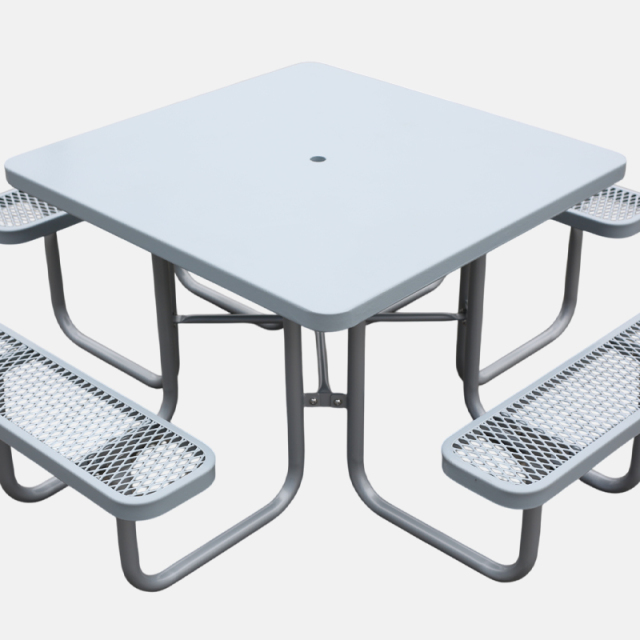
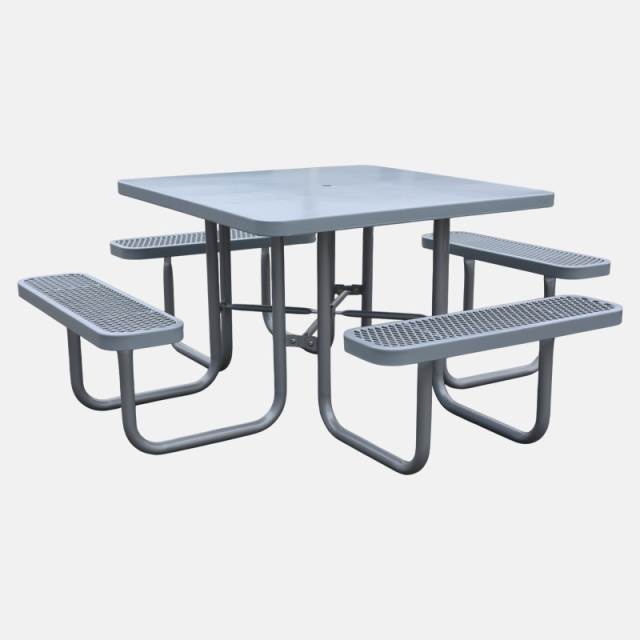
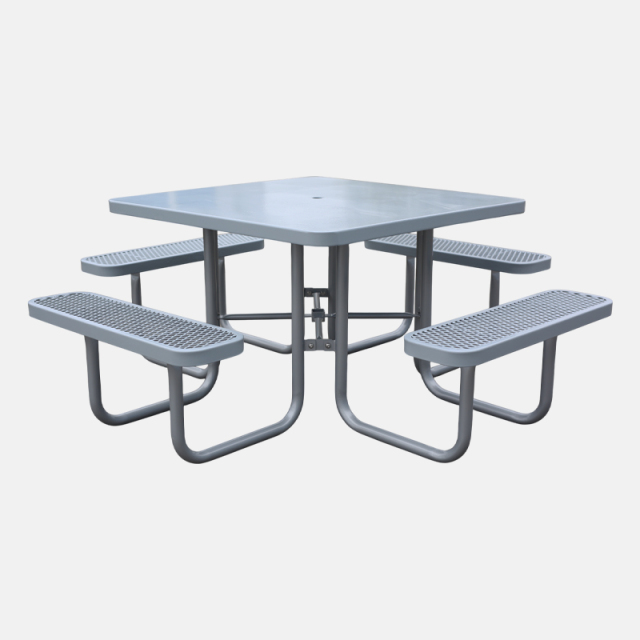
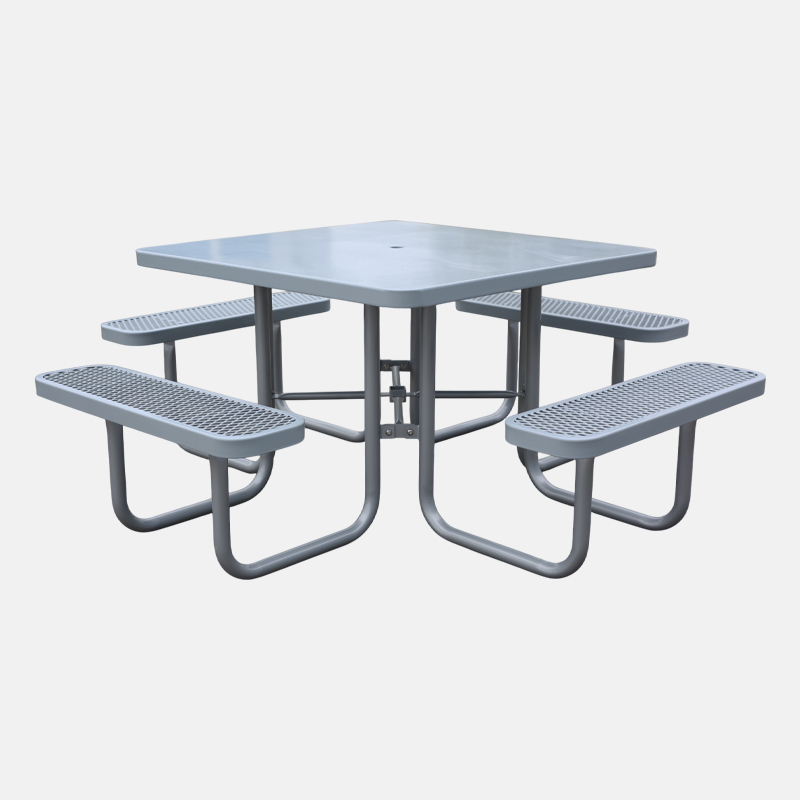
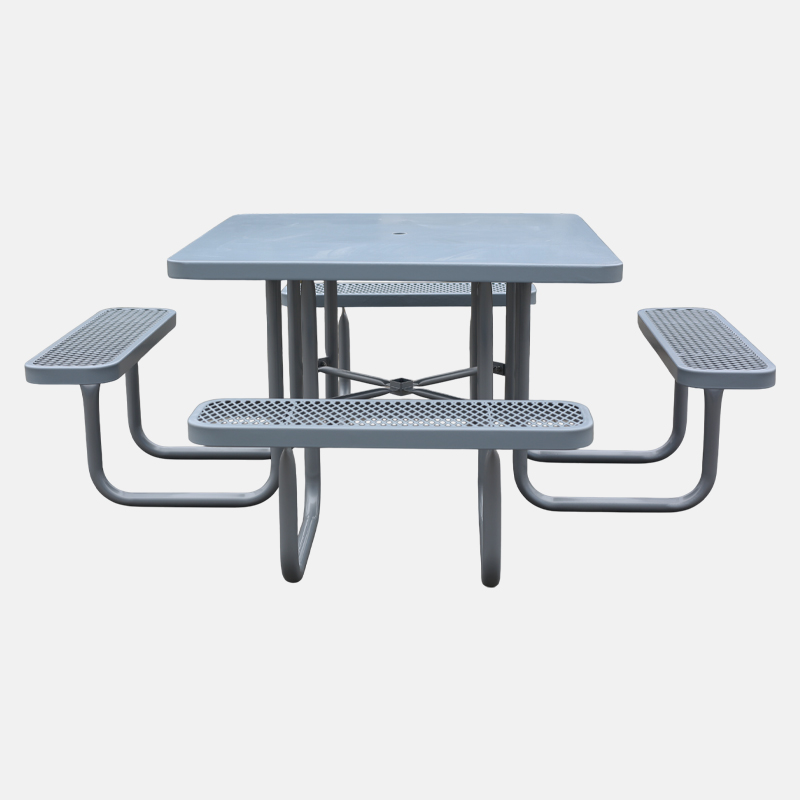
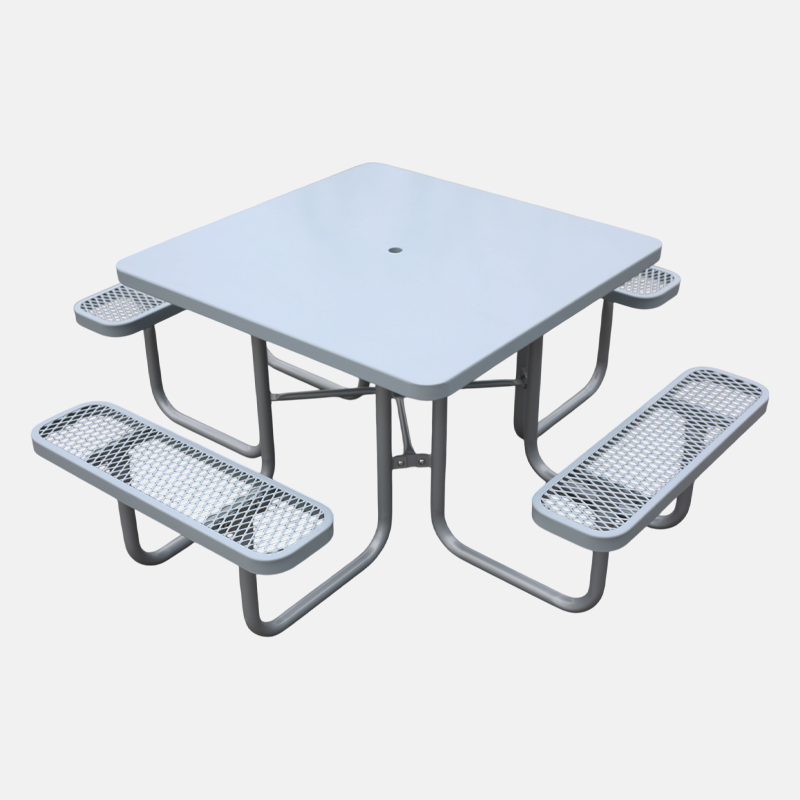
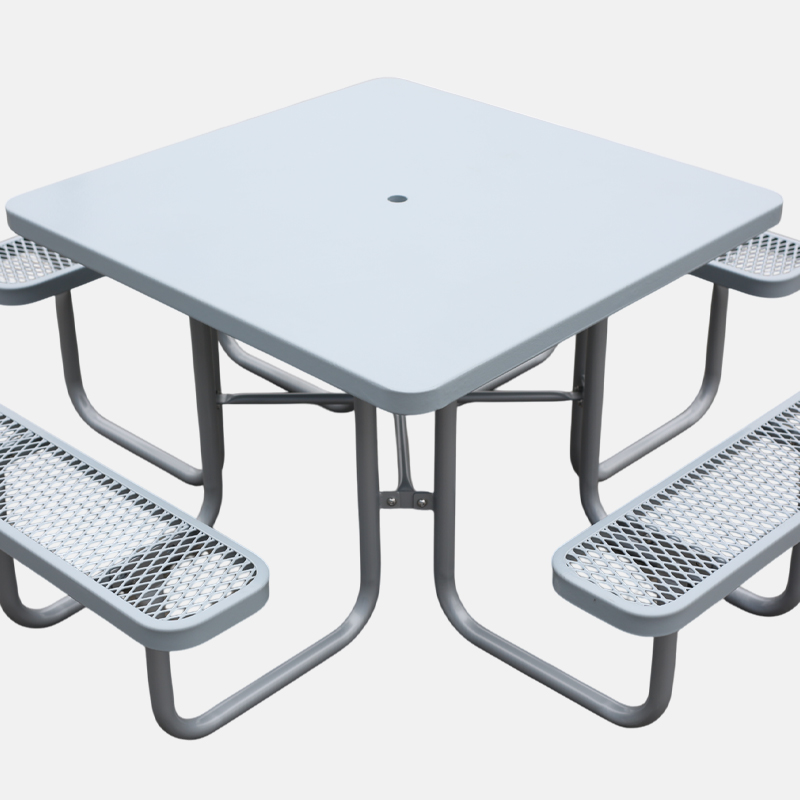
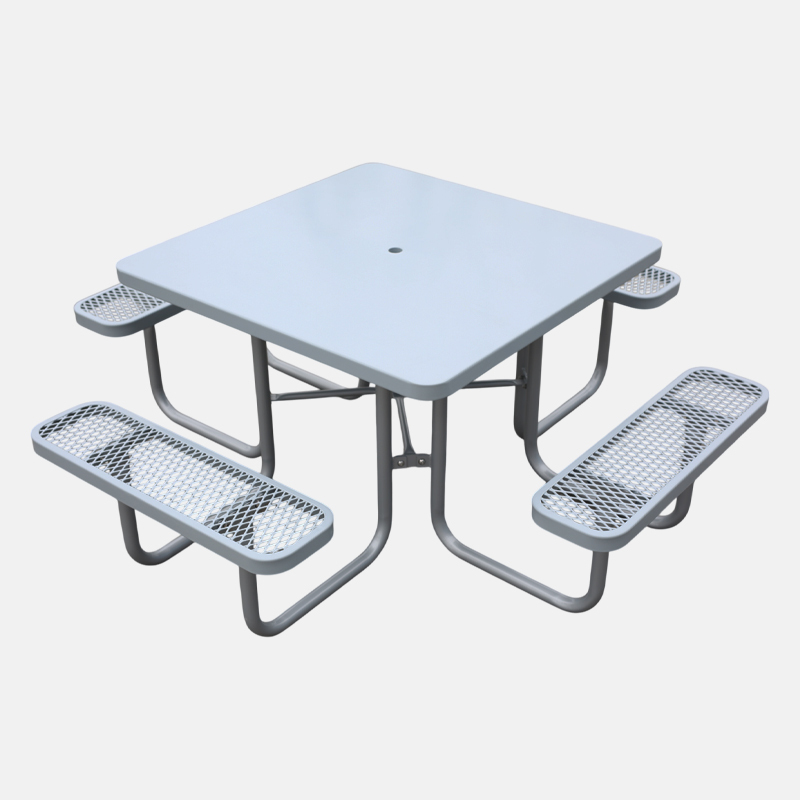
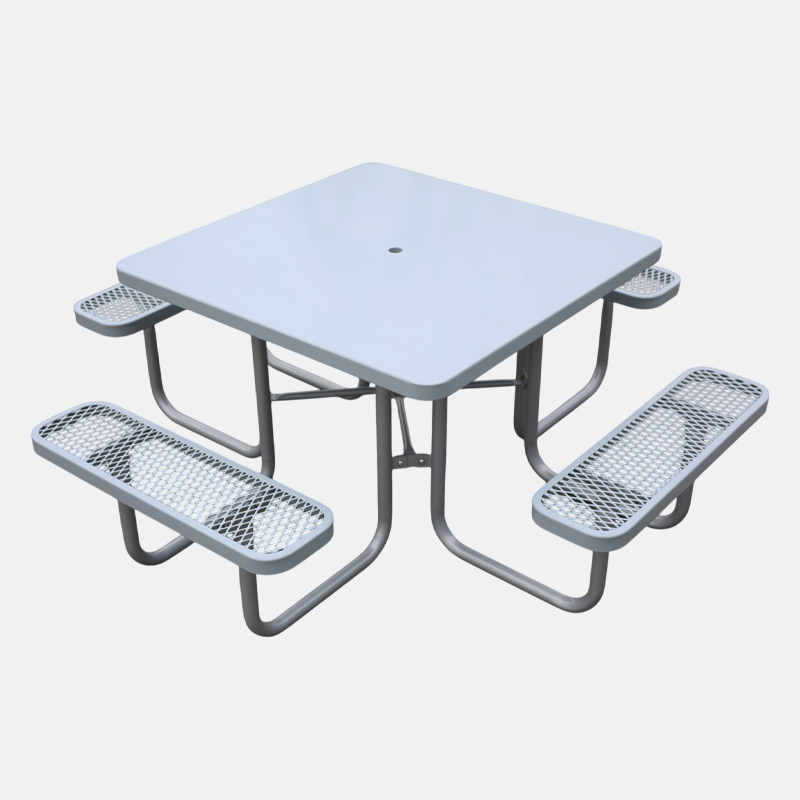
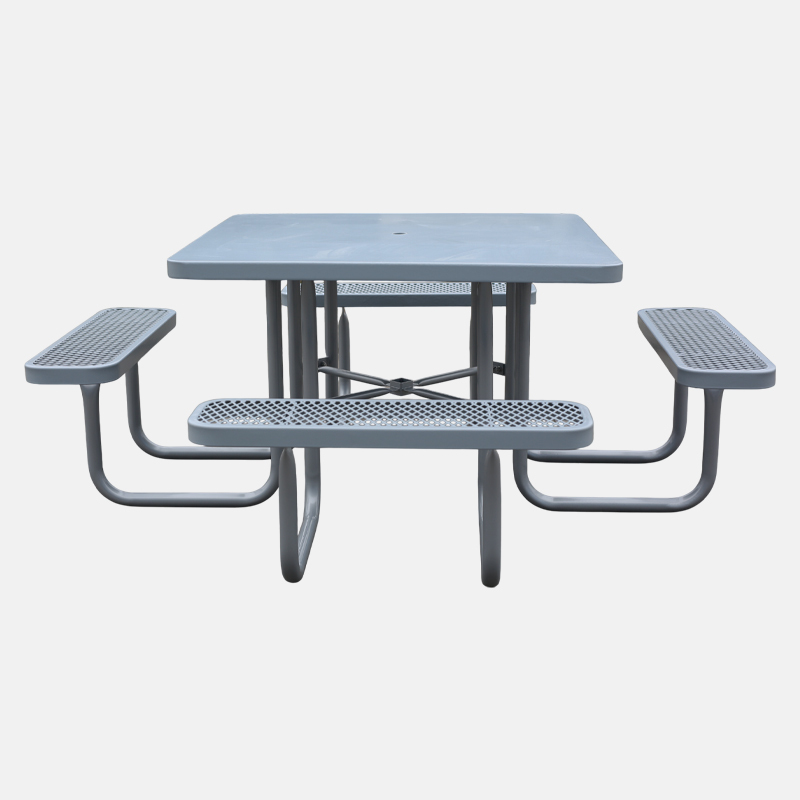
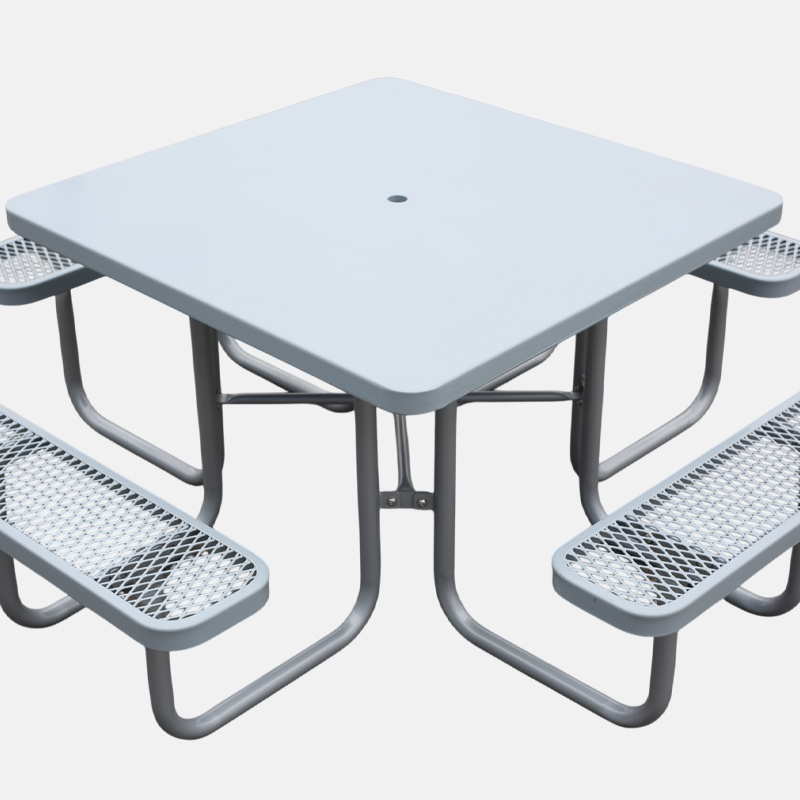
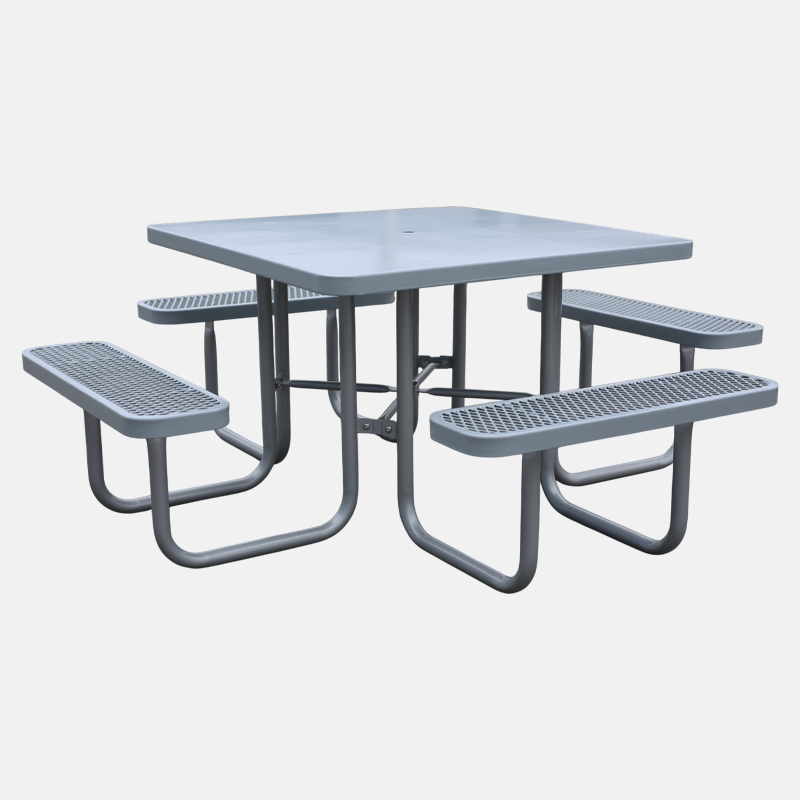
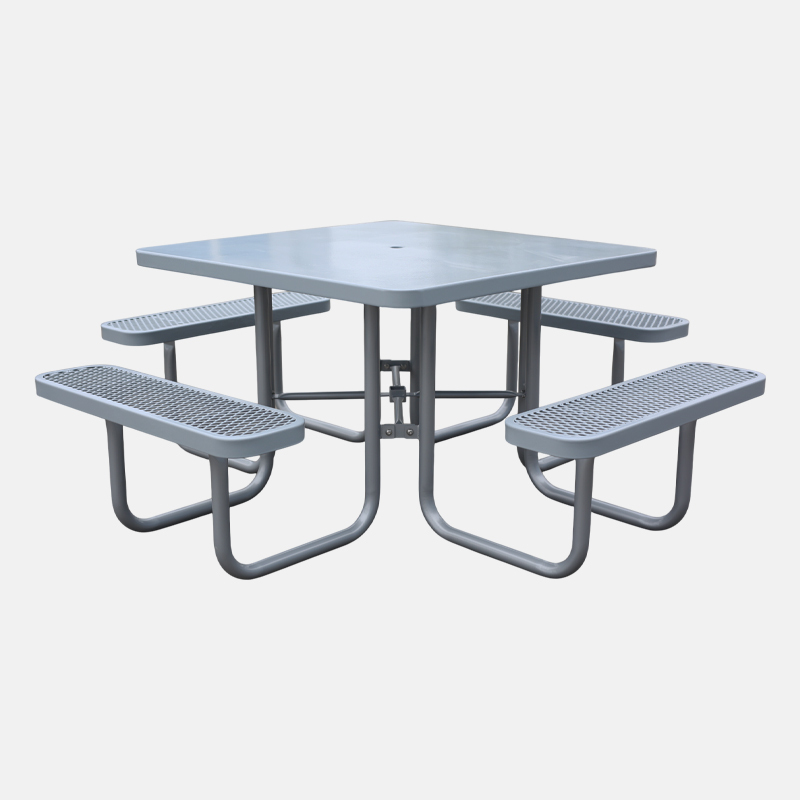
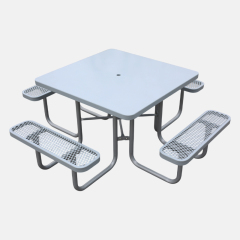
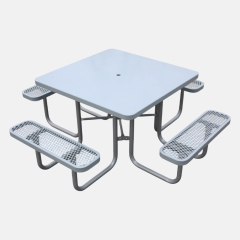
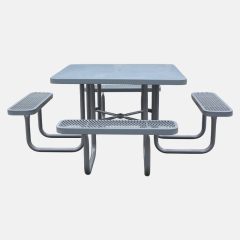
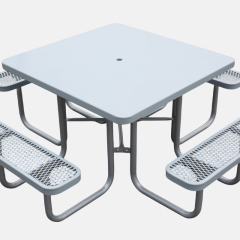
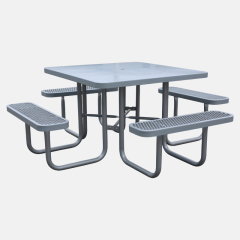
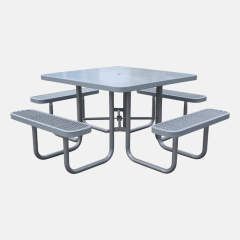
Stand at a public table that has been in service for a decade and you can usually read its history: rust bleeding from the bolt heads, a chalky top where the paint gave out, a paler patch where someone sanded a tag away. This 46 inch picnic table is specified to skip that sequence. A square outdoor table at this mass stays where the grounds crew put it. That is not a detail to skim: a lighter table can be walked out of position by two teenagers or lifted into a truck, and it starts to rock at the joints within a season or two. There is no maintenance calendar attached to it. No sanding, no sealing, no spring repaint, no re-tightening of timber slats that have dried and shrunk over winter. A hose, a cloth and an occasional look at the fasteners are the whole routine, and the surface a child leans on in July is the same surface that left the plant. If the seating point has to go through an accessibility review, say so at the start. This four-seat unit has no wheelchair position, and the 46-inch accessible stablemate in the same family is the one to specify for that spot.
What the Thermoplastic Skin Actually Does
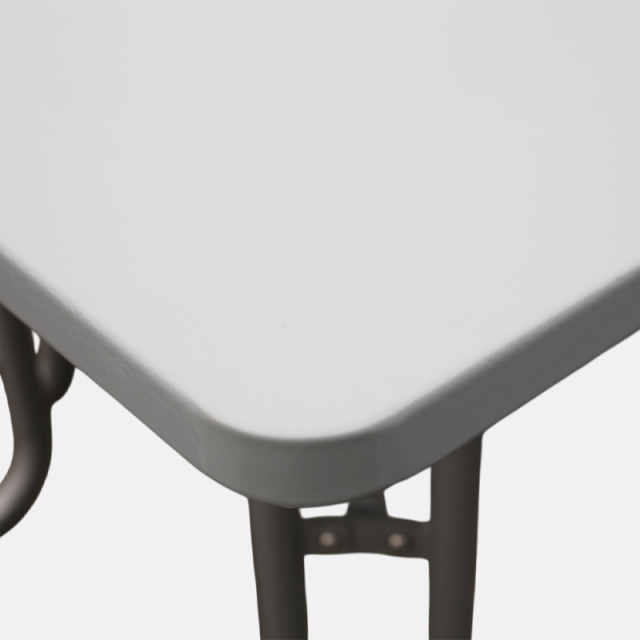
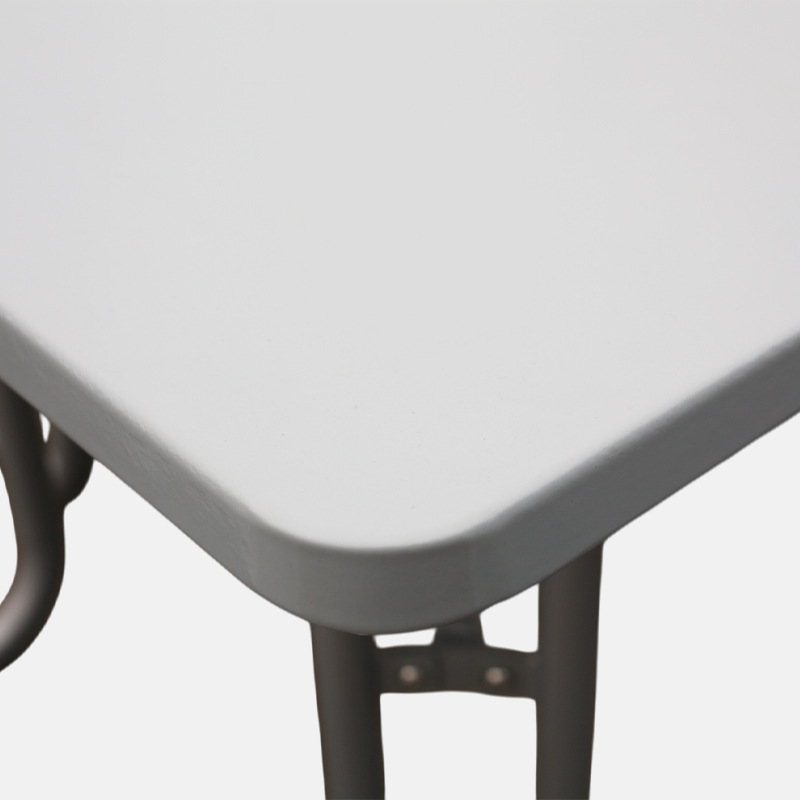
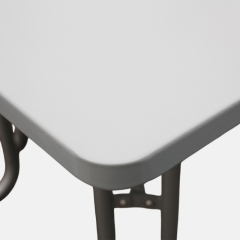
The skin is bonded to the steel, not sprayed over it. The 46 in top, both seats, the legs and the bracing all receive a thick thermoplastic layer that fuses onto a prepared, powder-coated frame. You are looking at a solid skin with steel inside it, not a paint film with steel waiting underneath.
Grime stays on the surface. The cured finish is non-porous, so spilled drinks, mud, bird droppings and playground grit do not work their way in. Mould has nothing to feed on, and there is no sealer to renew at the start of a season.
Colour holds through UV exposure. Inhibitors in the coating keep the gray from chalking to a pale wash the way unprotected paint does after a few summers outdoors.
A tag lifts with a cloth. Marker and spray paint sit on top of the skin. On painted steel the same tag usually means a patch repair, a colour that does not quite match and a second visit from a contractor.
Salt air does less damage. Nothing is left exposed to the weather, so coastal and humid sites do not get the creeping rust that starts at a scratch on a painted frame and spreads under the film.
No repainting line in the budget. For an outdoor picnic table that stays out all year, that matters more than the purchase price: the finish is the protection, so there is no refinishing cycle to fund.
Frame Build, Plate Surfaces and Fixings
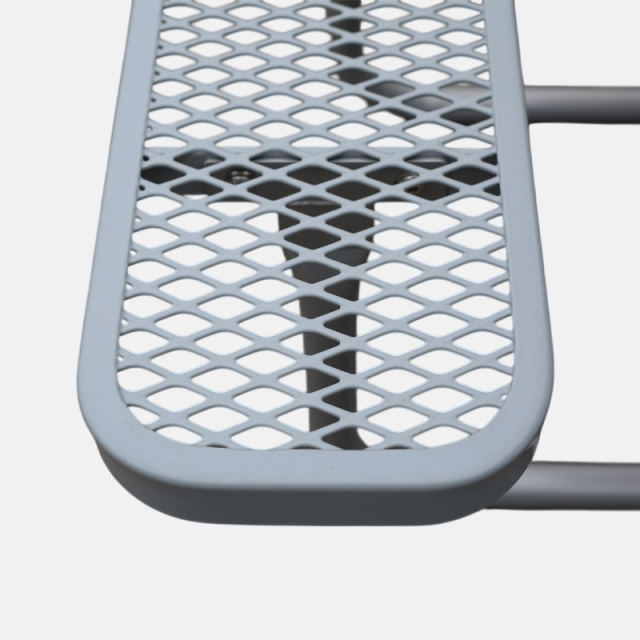
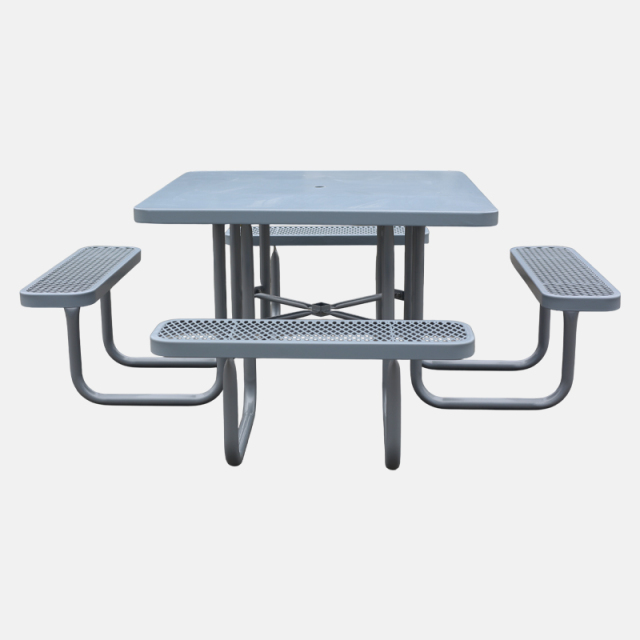
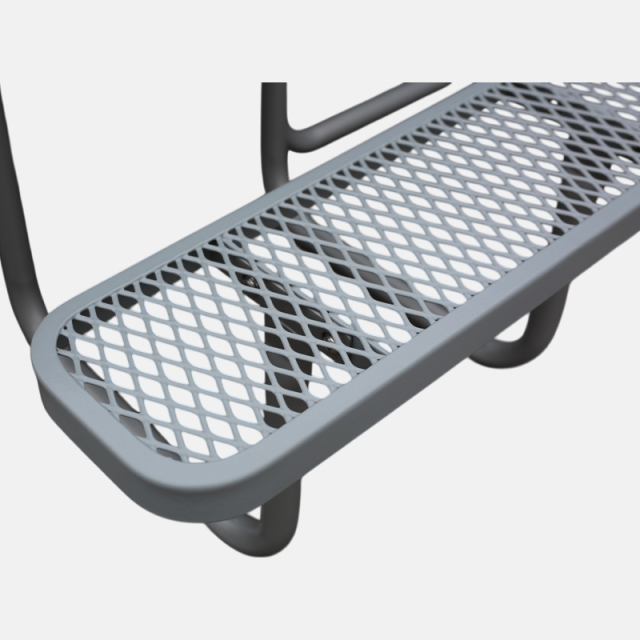
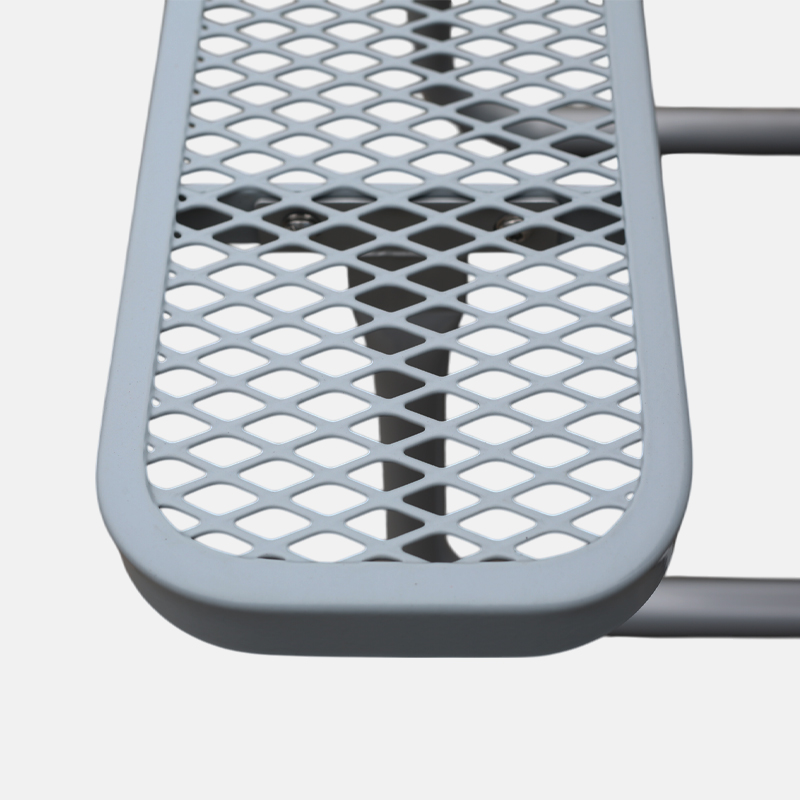
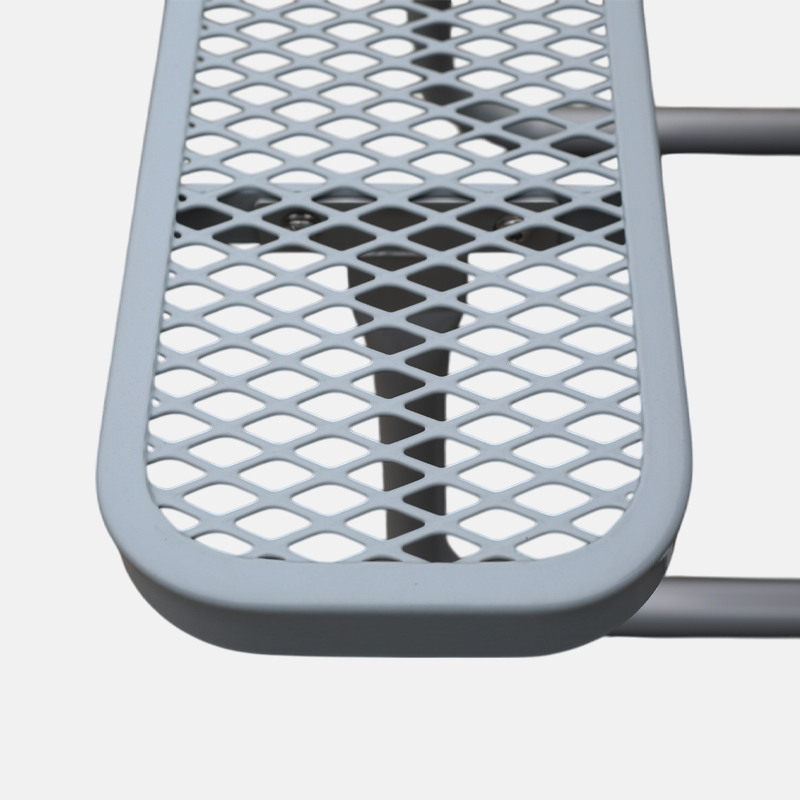
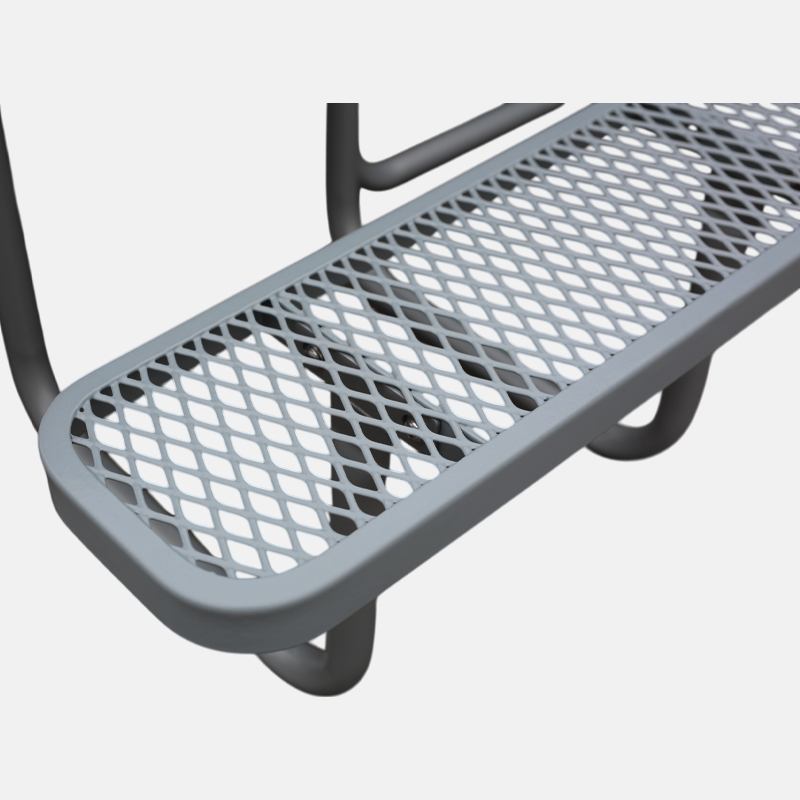
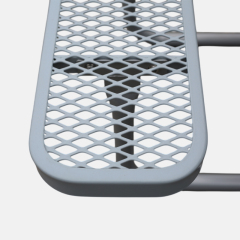
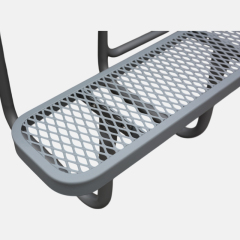
One bracket carries the table and both benches. The unit is not three separate pieces lined up and bolted on the pad. At that gauge the top does not oil-can when a group leans on it, and a seat edge keeps its line when someone stands up on it to reach over a fence. Stainless fasteners throughout. On a steel picnic table the fixings usually fail first: they rust, the rust bleeds down and stains the coating, and the heads round off before anyone gets a wrench on them. Stainless takes that failure out of the picture. Rounded seat edges. Seat edges and corners are radiused rather than left as a cut arris — the height a small child's head passes at when they run behind the bench. Weight carried low. Mass sits in the welded frame and the plate surfaces rather than in a bolt-on base, so the table resists being pushed out of position without an anchor.
Keeping the Surface Presentable
The weekly wash is water. On a surface this smooth, a hose and a soft brush take off dust, pollen and bird mess, and the coating needs nothing else to stay presentable. For sticky marks — juice, ice cream, sap, grease — a cloth and a mild household detergent do the job.
A pressure washer is fine at low pressure. A fan tip held at a sensible distance clears a table that has sat under trees all autumn. Keep the nozzle moving and do not hold it close to the seat edge or the rim of the umbrella opening, where the coating terminates.
Solvents are the one thing to keep away. Acetone, paint thinner and adhesive removers soften thermoplastic and leave a dull patch that stays dull. Abrasive pads and wire brushes do the same kind of damage more slowly, scratching fine grooves that trap dirt.
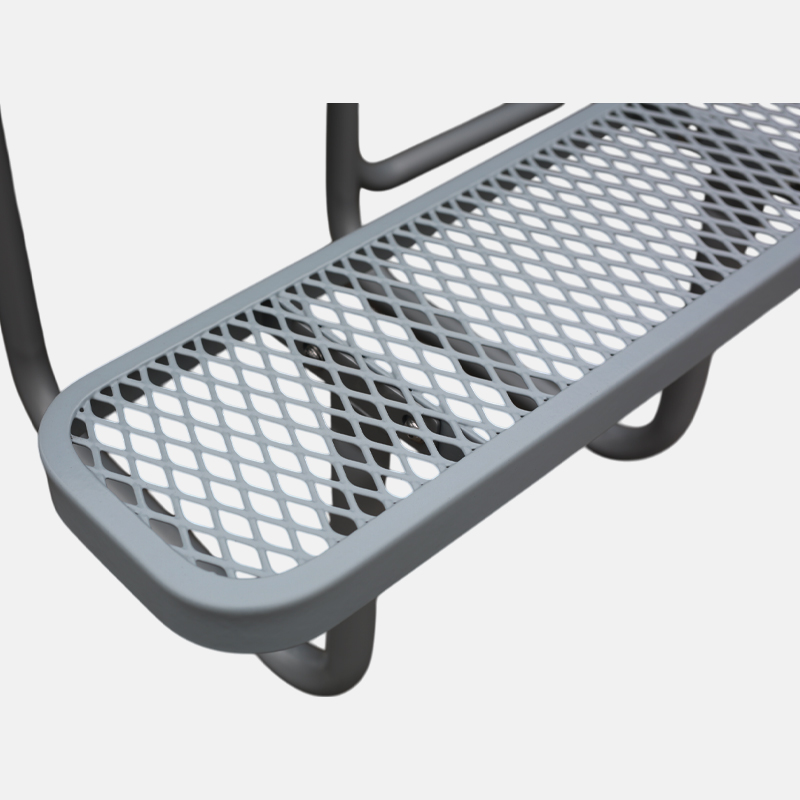
Clear the openings at the end of autumn. Leaves and seed heads that lodge in the pattern hold moisture against the surface; a brush over the top and seats takes a minute and keeps the table draining.
Do not budget for repainting. There is no waxing, sealing or recoating in the year for this table — the coating is the finish, and a deep gouge that reaches bare steel is the only thing worth acting on quickly.
Sun Exposure and Surface Heat
The top is steel, so it takes heat. The thermoplastic skin is there to stop rust, fading and graffiti — it is not insulation, and on a July afternoon the tabletop feels hot under the hand in the way any metal surface does, and hotter than timber or a plastic-lumber top. Nothing about the coating changes that. Colour is the biggest lever you control. Pale shades such as light gray, sand and pale blue reflect more of the solar load and stay comfortable to the touch longer; black, dark green and deep red absorb far more and read hot well before midday. On a school playground where children arrive in shorts, choose the lighter finish even where the site palette would rather have something darker — the seating still looks the same from the far side of the yard. Placement beats any coating choice. A table that sits in the shadow of a building, a tree line or a shelter through the lunch break is comfortable in a way no finish can make a sunlit one. Walk the site at midday before the position is fixed on the layout: the spot that is shaded at 12.30 in July is where the seating point belongs. A shade sail or an existing canopy over the table does the same job without touching the furniture. Managing it in service. Grounds and playground staff should check the seats and top by hand before sending children to the table on a hot day; a hose-down or a wet cloth brings the surface down within a minute or two and does the coating no harm at all. It is a five-second habit, not a maintenance task. We will not quote a surface temperature. There is no published figure, because the reading moves with colour, air temperature, wind and time of day. If a safety review asks for one, take it on a sample at the hottest hour on your own site, and specify the lighter colour if it comes back high.
Accessibility Clearance and Approach
This is the standard unit, not the accessible one. Four fixed positions sit on two benches and there is no open end, so a seating point that falls inside an accessibility review needs the 46 inch accessible table in the same family instead — whatever colour or fixing has been chosen for the rest of the site. - The review looks at clearance, not at the silhouette. A table can have a gap at one end and still fail, because a wheelchair user has to pull under the top rather than sit at the end of it. The accessible version extends its tabletop past the bench line at one end to give that clearance; put the actual figures into the review instead of simply describing the table as accessible. - One wheelchair position per table. The 46 inch accessible model opens one end, giving a single space beside four seated places. Where two wheelchair users commonly arrive together, the 8 ft double-sided table opens both long sides — a different unit with a different footprint, so plan it into the layout from the start rather than adding it after the groundworks. - Most sites need a mix. Accessible tables at the right intervals along a path or across a courtyard, standard tables everywhere else. Send the seating plan with the required points marked and the quantity can be split between the two versions, finished to one colour and shipped together. - What you will be asked for. The clear floor space in front of the table, the surface it stands on, the route to reach it and the height of the top and seats. Take those from the layout drawing rather than from a photograph of a similar site. - Raise it early. Accessibility requirements usually surface after the furniture package has been priced. Flagged at enquiry, the version is settled before the coating run; raised after the crates have sailed, it becomes a second order. Attribute | This four-seat table | 46-inch accessible stablemate --- | --- | --- Tabletop | 46 in × 46 in square | 46 in × 58 in, extended at one end Overall footprint | 80 in × 80 in | 80 in × 65 in Seated positions | Four, on two fixed benches | Four plus one wheelchair position Unit weight | 315 lb | 280 lb Wheelchair access | None — no open end | One position at the open end Umbrella opening | Central opening through the top | 1.75 in through the top Finish | Solid gray thermoplastic | Thermoplastic, colour set by the project Typical use | Standard seating points across a site | Any point that has to pass an accessibility review
Where This Square Table Earns Its Keep
School grounds and playground edges. Between break and lunch this table takes more use in an hour than a patio set sees in a year: four seats, no backrest to climb over, no gap under the top for litter to gather. Districts specify it as a heavy duty picnic table because it stays square and stays put with a few hundred students moving around it.
Parks, greenways and trailheads. Set where a path widens or a lawn meets paving, it gives families a defined place to stop instead of a worn patch of grass. It needs level ground and nothing else — no footing, no mowing strip, no annual attention.
Campgrounds and recreation areas. This is where an all weather outdoor picnic table earns its keep: the unit stays out from the first warm weekend to the first frost, takes rain, strong sun and campfire smoke, and is never winterised.
Plazas, courtyards and community centres. The 80 in square footprint lines up with a paving grid, sits flat against a wall or stands free in the open, so it can be placed from a sketch rather than a landscape drawing.
Hospitality patios and event grounds. For a terrace that stays open all season, the table gives a commercial look with none of the refinishing a timber set demands, and it can be re-laid when the floor plan changes.
Dimensions, Weight and Materials
Specification
Detail
Model
TB62
Overall footprint
80 in × 80 in × 30.5 in
Tabletop
46 in × 46 in, 2 in thick, 30.5 in high
Seats
38 in × 12 in, 2 in thick, 18 in high
Seating capacity
Four people
Unit weight
315 lb
Top and seat material
2.5–3.0 mm steel plate
Frame
42 mm welded steel pipe bracket
Frame finish
DuPont outdoor powder coat
Top and seat finish
Solid gray thermoplastic coating
Fasteners
Stainless steel
Umbrella provision
Central opening through the tabletop
Base
Freestanding, no anchor required in normal use
Assembly and Fixing on Site
The table arrives knocked down in a crate — top, two bench seats, the welded frame, a bag of stainless fasteners and the assembly sheet. Book a delivery window and the labour for that day rather than expecting units ready to use off the truck.
Assembly is bolting, not fabrication. Hand tools are enough; nothing is cut, drilled or welded on site, and the fasteners in the crate are the ones specified for the unit.
Run the bolts up with two people.
Stand it on level, compacted ground or paving. The frame sits flat on its own base, so there are no footings to dig and no pad to pour unless your specification calls for one.
Settle the fixing question before the order, not on delivery day. The table is freestanding as supplied; where a site requires anchored furniture — a theft-prone location, exposed windy ground or a tender clause — tell us when you enquire and we will confirm the arrangement for this model rather than leaving you to assume a bolt-down kit is in the crate.
Check the fasteners after the first season. A pass with a wrench once the table has settled keeps the top and benches tight and stops water sitting in a loose joint.
How the Order Is Built and Shipped
As a commercial picnic table manufacturer we plan each order backwards from the date the table has to be on site: once the model, quantity and finish are fixed, the coating run and the freight are scheduled against that date rather than against the day the order lands.
Minimum order. It is 10 pieces as a rule and it does vary by item, so check the figure that applies to your order rather than budgeting off the general one.
Lead time. Production runs from 10 days depending on the product; on a project with a fixed hand-over, give us the date first and we will confirm what is achievable before you commit.
Colour is signed off before the run is scheduled, from a physical swatch rather than a screen, so the gray that arrives is the gray that was agreed.
Umbrella poles are supplied by the buyer. Tell us the pole diameter when shade is part of the scheme and the central opening is set to suit it.
Packing is planned around the destination. These are heavy, crated units that need lifting equipment on arrival — say what will be available and the crate and pallet plan is built around it.
Commercial terms are fixed at quotation: shipping terms, payment and delivery point are set out in the quote alongside the confirmed quantity and lead time rather than assumed.
Changes go straight to the line. Colour, dimension or logo changes are production instructions here because cutting, welding and coating happen under one roof rather than in three subcontractors' queues.
- Solid gray is the build shown here. It is the standard thermoplastic finish on this table; other shades are run to order. - 21 standard thermoplastic colours sit on the palette, which is how a district or a campus keeps a whole site on one scheme instead of matching by eye from one delivery to the next. - Custom matches are worked from a supplied swatch, paint code or reference sample, and agreed from a physical piece before the run is scheduled rather than from a screen. - Logo and branding are applied during production from vector artwork (AI, EPS or PDF), placed on the seat ends, the centre of the top or the frame rail, and set on a layout drawing first. - Dimensions can be adjusted for a project run, with the drawing signed off before cutting and welding begins. - Tabletop pattern — expanded metal or punched steel — is a visual choice as much as a functional one on this metal picnic table, and both are coated to match. - In-house from start to finish. As a commercial picnic table manufacturer we cut, weld, coat and brand under one roof, so tables, benches and bins for one site arrive finished to one standard.
Scale & Supply Capability
Arlau is a manufacturer, not a middleman: Chongqing Arlau Civic Equipment Manufacturing Co., Ltd has been producing outdoor furniture and public facilities since 1999, more than 26 years in the trade. Our 13,000 sqm factory runs a fully automatic robot production line with an annual output of 130,000 pieces, and a 100-person team covers production, export paperwork and after-sales follow-up. Goods ship to more than 80 countries and regions. OEM/ODM one-stop export service is handled in-house, so you keep one contact from drawing to delivery.
FAQ
Is the whole table coated, or just the tabletop?
Every surface is coated — tabletop, both bench seats, legs and bracing. The frame goes through a DuPont outdoor powder coat first, then the thermoplastic layer is fused over the finished assembly, so no weld, cut edge or fixing boss is left bare. It is the difference between a table that is painted on its top and one that is encapsulated; on this outdoor picnic table, the second is what keeps rust from starting at a joint you cannot see.
How much space does it take up once assembled?
The footprint is 80 in × 80 in and the top stands 30.5 in high, with the seats at 18 in. That 80 in square is the figure to use when spacing it against a path, a wall or a neighbouring table, and it is worth leaving clear working room on at least two sides. A 46 inch picnic table of this size seats four people, two to a bench.
Will it stay put without being anchored?
Yes, in normal use. At 315 lb, with the mass carried in the welded frame and the plate top, a heavy duty picnic table of this build resists being pushed out of position and needs no footings. If a site requires anchored furniture — a high-theft location, exposed windy ground or a specification clause — that has to be arranged before production, because this model is freestanding as supplied.
What keeps the benches level with the tabletop over the years?
A single welded steel pipe bracket carries the top and both seats, so the benches cannot settle independently the way three bolted assemblies do. Stainless fasteners hold the unit together without the rust bleed that loosens a fixing over time, and one wrench pass after the first season confirms everything is still tight.
Can this table serve a seating point that has to be wheelchair accessible?
No — this is the four-seat standard unit, with a bench down each side and no open end. The 46-inch accessible table in the same family extends the top to 46 in × 58 in and opens one end for a wheelchair approach, at 280 lb. Where a review covers several seating points, split the quantities by position and both versions can be finished to one colour and shipped together.
Can a later phase of a project be matched to the first delivery?
Yes. Colour, coating and fixing positions are set from our own drawings and tooling, so a second order placed months later can be run to the same standard. As an outdoor picnic table supplier we keep the layout on file; send the original colour reference or the project name with the repeat order and the match is checked before the run is scheduled.
Which cleaning products should be kept away from the coating?
Acetone, paint thinner, adhesive removers and any solvent-based cleaner will soften the thermoplastic and leave a dull patch. Abrasive pads, wire brushes and scouring powder do slower damage by scratching grooves that trap dirt. Water, a mild household detergent and a soft brush cover everything the surface normally meets, and a low-pressure fan tip is safe for heavier grime.
Established in Shenzhen, China, Arlau has been a leading manufacturer of high-quality outdoor and garden furniture for over 26 years. Specializing in custom design, production, and global distribution, we proudly serve clients in more than 80 countries worldwide with our durable, stylish, and functional outdoor solutions.