What Accessibility Means at This Table
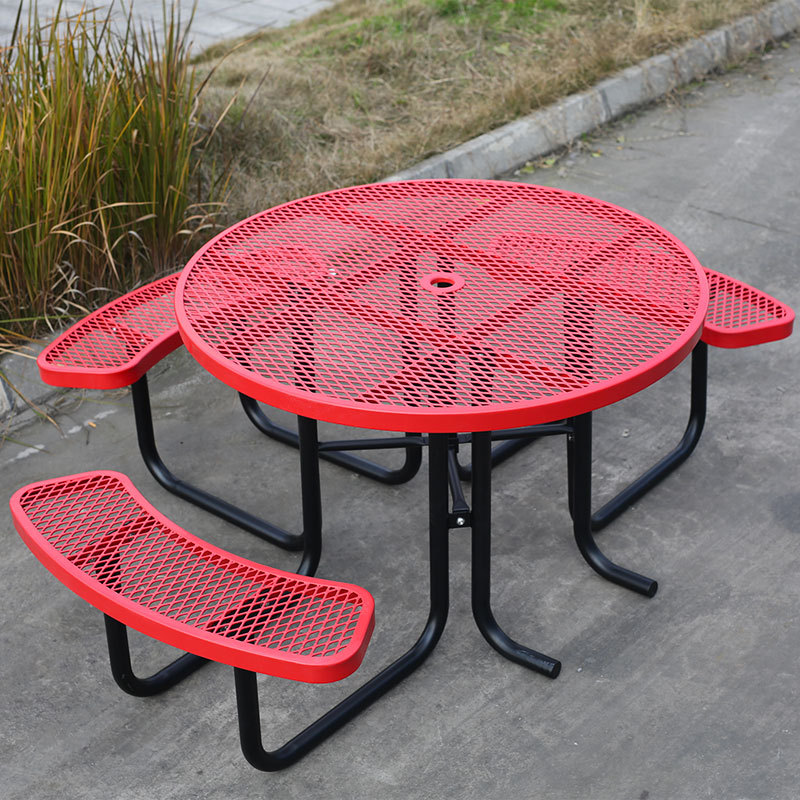
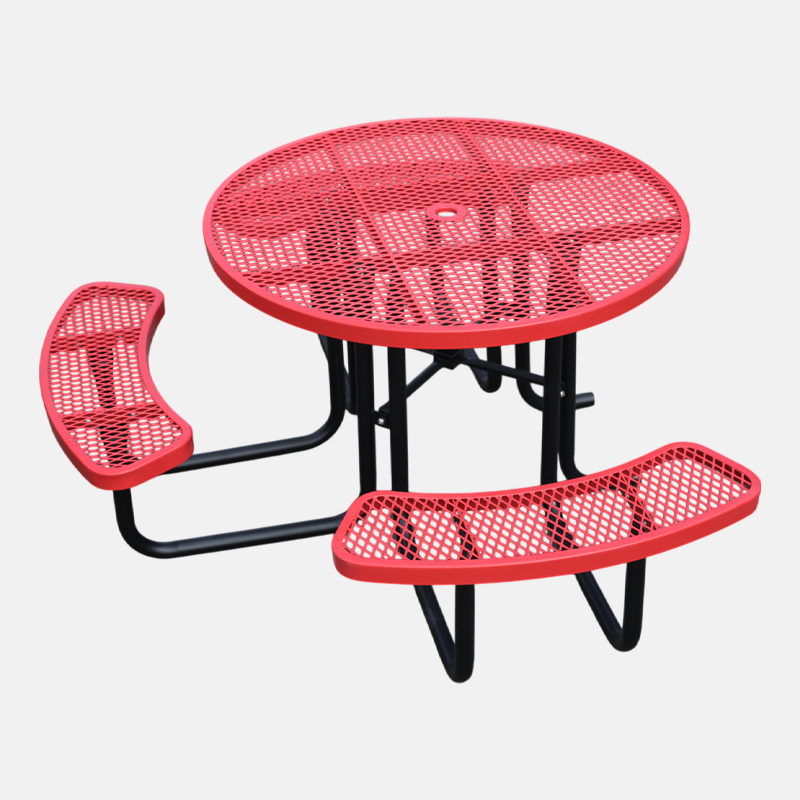
- An open bay, not a cut-down end. One long side of this 46 inch picnic table carries no bench at all, so a wheelchair rolls directly to the table edge instead of stopping at a seat frame and transferring sideways. The user joins the table on the same terms as everyone else.
- Clearance for knees and footrests. The tabletop sits at 30.5 in and the frame beneath it is left open, with roughly 28 in of clear height under the top. Footrests, knees and the chair's own armrests pass below the edge rather than catching on it.
- One tabletop height for the whole table. There is no lowered tray at the end and no separate accessible seat. Everybody eats, works and leans on the same 46 in surface at the same height.
- Companion seating opposite and beside. The remaining platforms wrap around the other sides, so two, three or four people sit with the wheelchair user rather than around a separate table.
- Aim the open bay at the path. Usability is decided as much by the pad as by the table. Put the open side toward the walkway or paved apron, on firm level ground, and leave the grass side for the benches.
- A stable base under the approach. At 220–225 lb the table does not shift when someone pushes against the edge while transferring, which matters more on an accessible table than on any other.
- Specifier support. As a commercial outdoor seating supplier we keep table heights, seat spacing and the open-bay width consistent from one order to the next, so the drawing you approve is the table that arrives. If an accessibility reviewer wants the clearance figures set out in writing, tell us before production and we will confirm them against your layout.
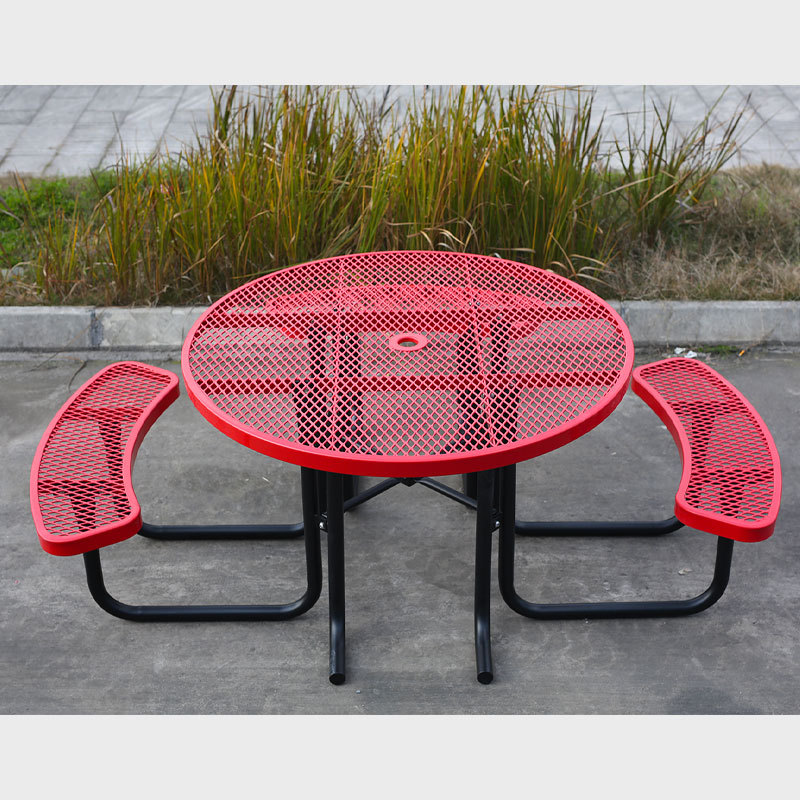
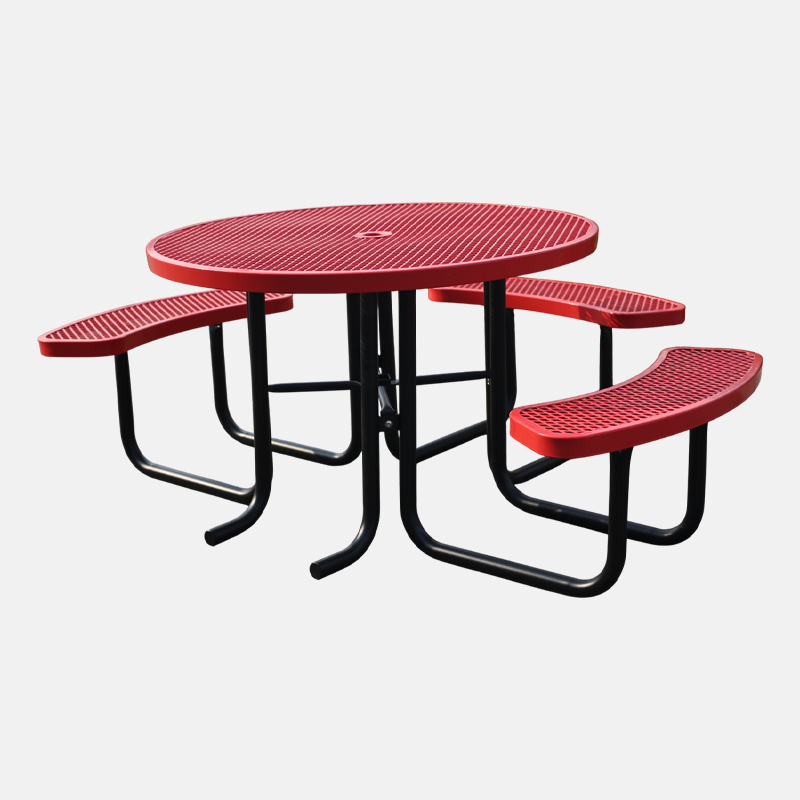
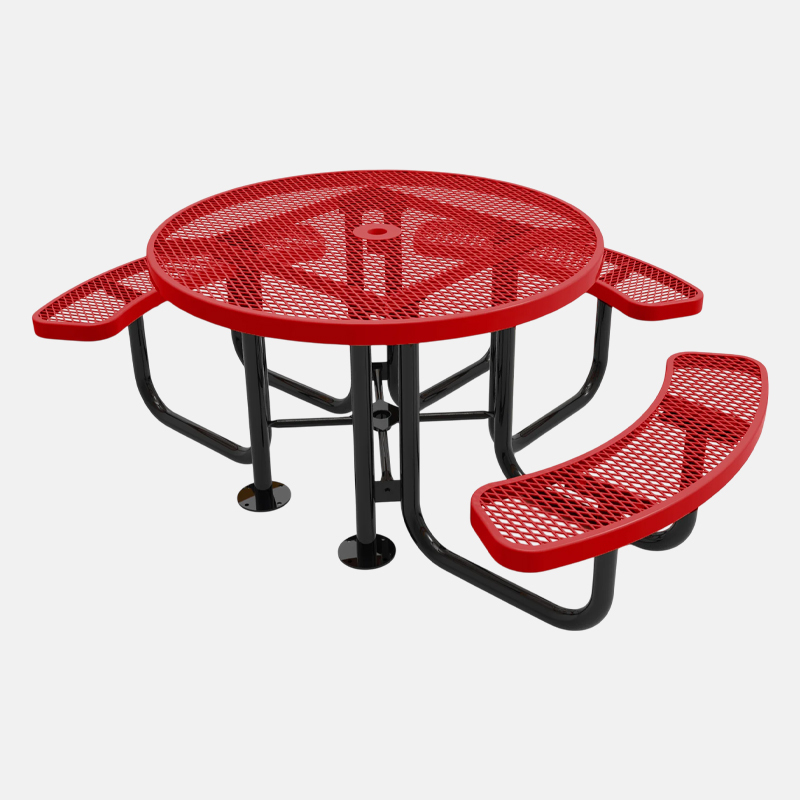
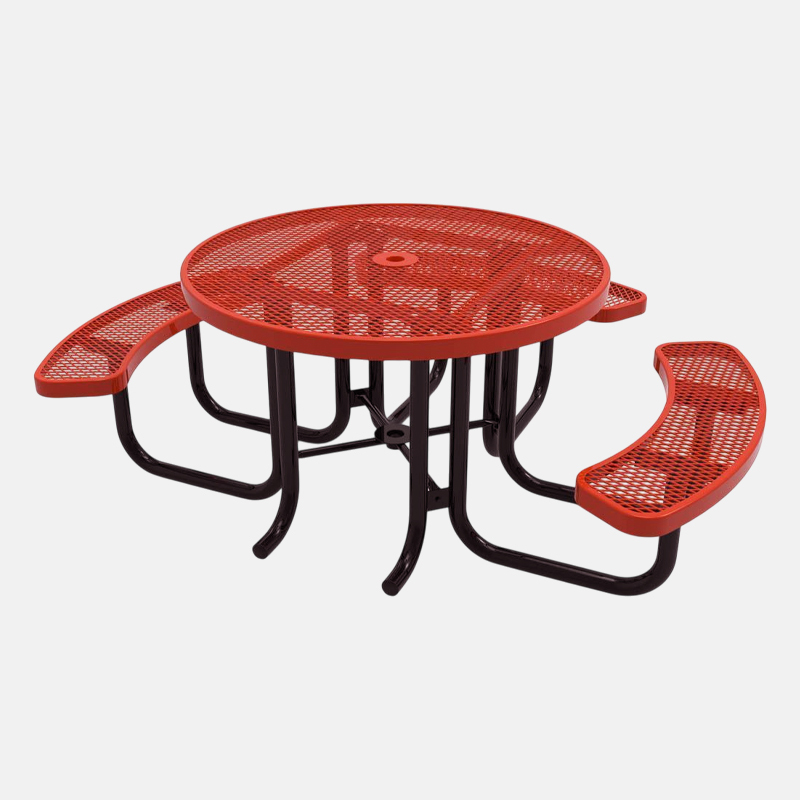
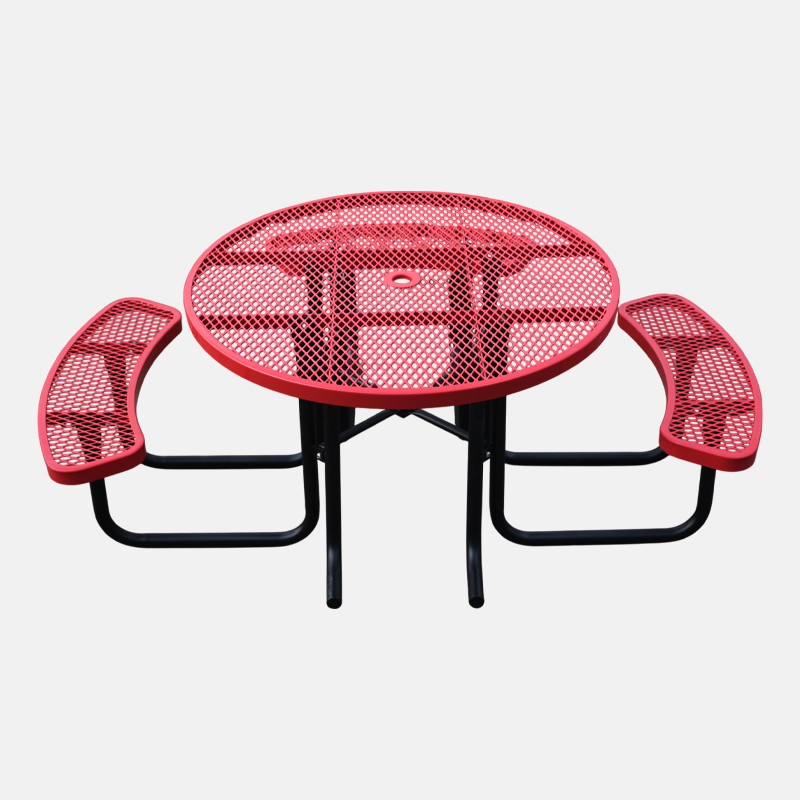
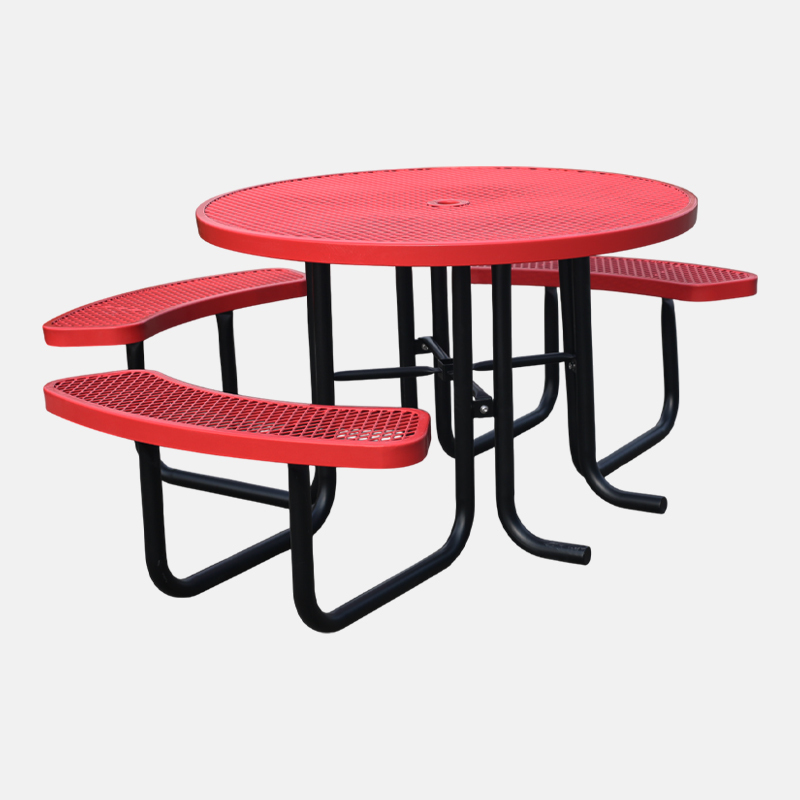
- Arlau TB12 is a 46 in round picnic table with one side deliberately left open. Rather than a bench running the full way round, the tabletop extends out over an unobstructed bay, so a wheelchair user can roll up to the same surface as everybody else and eat at the same height. The remaining seats wrap the other sides, and the table can be ordered with two, three or four of them to suit the site. The top is perforated metal, expanded metal or punched steel, 2.5–3.0 mm thick, carried on a welded steel pipe frame and finished so the whole unit can stay outdoors all year. Nothing needs repainting, sealing or re-staining, and there is no timber to rot or splinter. Where a park, campus or campground has to show that its seating works for every visitor, this is the commercial picnic table that makes the answer simple: everyone sits at one top, at one height, at the same time.
Metal Mesh Top & 81-Inch Footprint
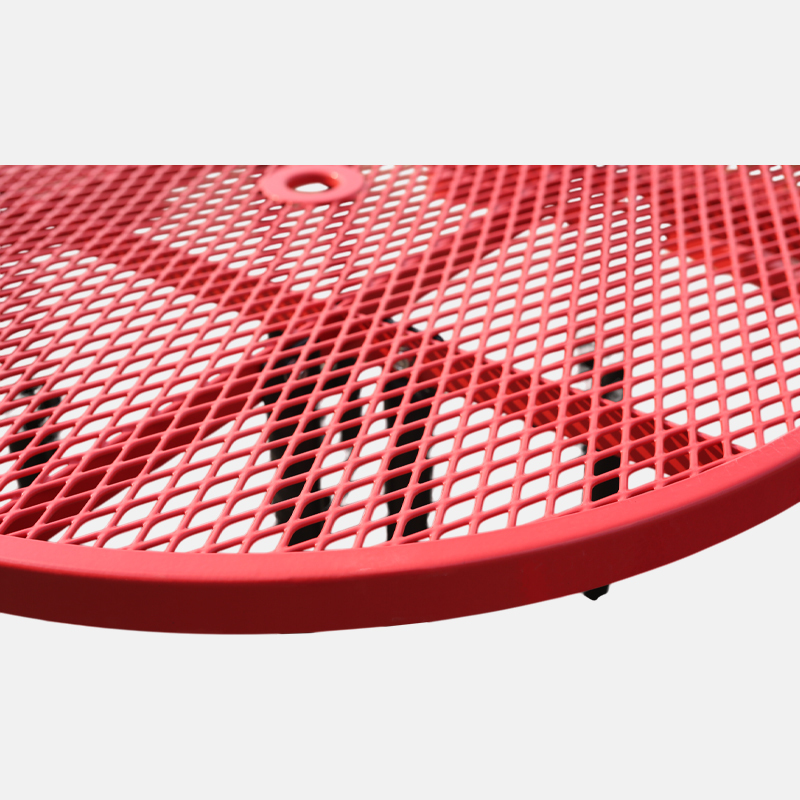
Overall the table measures 81 in long by 63.5 in wide, with a 46 in diameter top and a 2 in thick edge. Nearly all of that footprint is table and seating rather than legs, and the base is spread wide, which is why the table sits steady without being bolted down. The tabletop is perforated rather than solid. Rain falls straight through instead of pooling in the middle, so the surface is usable again minutes after a shower, and grit, leaves and sand come off in one pass with a brush. On a metal picnic table the open pattern also means there is no large flat plate holding water against the surface, which is what shortens the life of most outdoor tables in wet climates. The 46 inch picnic table still leaves room on top for plates, a cool box and elbows without crowding the people opposite.
Steel Frame & Coating Build
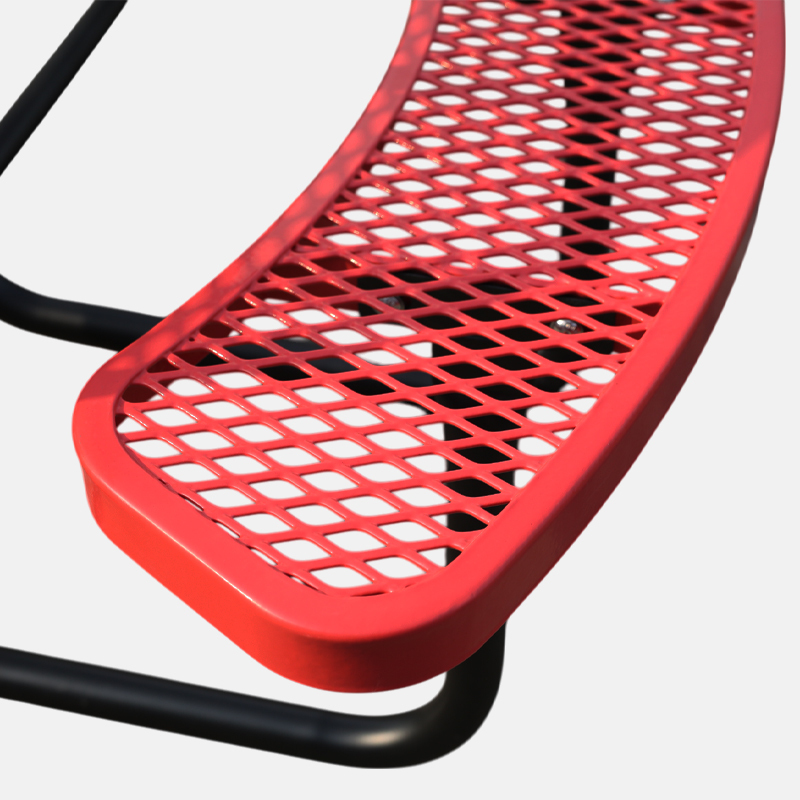
Two finishes meet on this table, and that is deliberate — both are applied in the same picnic table factory, and each is chosen for the job it does. The tabletop and the seat platforms carry thermoplastic, a thick fused layer laid over a hot-dip galvanised steel core, while the frame is welded steel pipe finished in DuPont outdoor powder coat in black. The top and seats take the daily abrasion from trays, bags, keys and cleaning brushes, so they get the thicker, softer, grippier coating. The frame only needs a hard colour coat that resists chipping where it flexes at the joints.
Together the two layers are what make this an all weather outdoor picnic table rather than a fair-weather one. The galvanising protects the steel from the inside and the thermoplastic seals it from the outside. The finished table is rated for -30 °F to 120 °F, the surface is slip-resistant and splinter-free, and the fixings are 304 stainless steel, so the parts that usually start to bleed rust on outdoor furniture are the parts that will not. There is no wood to oil, no paint to touch up and no sealer to reapply.
Care & Maintenance
- Routine wash. Warm water, a mild detergent and a soft brush lift most dirt off the thermoplastic. Rinse and let the mesh drain; there are no crevices to dig into.
- Stubborn marks. A power washer on the tops and seats is acceptable when normal washing is not enough. Keep the nozzle moving and work at a sensible distance instead of holding it against the coating.
- What to avoid. Anything containing acetone, and solvent-based cleaners generally. They attack the coating rather than the dirt.
- No refinishing, ever. Because it is an all weather outdoor picnic table, there is no annual repainting, sealing or oiling programme to budget for. The colour is part of the coating, not a film sitting on top of it.
- Seasonal check. Once a year, check the 304 stainless fixings and the anchors, clear leaves and sand out of the perforations so the top drains as designed, and look over the seat platforms for movement.
- Parts and advice. Replacement fixings and finish guidance come from the same picnic table factory that built the table, so a small repair years later does not mean replacing the unit.
Installation & Anchoring
- Choose the fixing before the pad is poured. A ground sleeve set into concrete gives the most permanent, tamper-resistant installation on new work; expansion bolts into an existing slab are the practical choice where concrete is already down, so confirm the fixing with your commercial outdoor seating supplier before either is due on site.
- Set out the envelope and the approach. Allow 81 x 63.5 in for the table itself plus clear, level ground in front of the open bay, facing the walkway or apron.
- Prepare the base. Cast the sleeve into the footing, or drill and set the anchors to the depth your fixing supplier specifies, and check them for level before anything else goes on top.
- Lift the metal picnic table into position. At 220–225 lb this is a two-person lift with a dolly. Assemble and set it on the pad where it will stand rather than building it elsewhere and carrying it.
- Fix it down and check it for square. Drive the 304 stainless screws evenly so the frame is pulled down flat rather than twisted. A heavy duty picnic table bolted down out of square will rock on the slab.
- Measure the accessible side last. Re-check the clear space under the tabletop and the approach area before hand-over — those two measurements are what an accessibility review will ask for.
Seating Layout & Weight
- Two, three or four seats. Most commercial picnic tables arrive in one fixed layout. This one can be ordered with two seats for a courtyard or a spot against a wall, three for a corner, or four where the table has to carry a group. - Curved platforms, 38.5 x 11.5 in. Each platform follows the table edge, so people sit facing the middle instead of perching on a corner. Seat and top share the same 2 in profile, which is what gives the edge its rounded feel under the leg. - Seat height of 18 in. That is the height most adults sit down to, and it is also the height a wheelchair user transfers to and from if they would rather slide across onto a bench than stay in the chair. - 15 in between platforms. The gap is what gives each person room to get in and out without climbing over the frame, and it keeps the table from feeling like one long bench with dividers. This is a heavy duty picnic table in the literal sense, and the weight is doing real work. - What the weight buys. A table this heavy does not walk across a lawn, tip when somebody leans on one edge, or slide when a wheelchair is manoeuvred against it — the three things that put outdoor tables out of service first.
Where the Table Works
- Public parks and playgrounds. A commercial picnic table beside the play area that a grandparent in a wheelchair can pull up to, rather than watch from the path. Sit it on the route between the entrance and the playground and it earns its space every day. - Schools and universities. Outdoor dining and study space where students using chairs sit with everyone else. The 46 in top is large enough for books and laptops as well as lunch. - Campgrounds and beaches. Barrier-free dining on ground that is often soft and in weather that changes fast — the case for an all weather outdoor picnic table. The mesh drains, the coating wipes clean, and the heavy base stays put on a gravel or hardened sand pad. - Senior living communities and hospital grounds. Seating that is easy to approach, slip-resistant underfoot and free of splinters and sharp edges, and one where a resident can sit beside a visiting relative who uses a wheelchair. - Whole-site furniture packages. Working with one commercial outdoor seating supplier keeps the scheme consistent: Arlau also builds the benches, litter bins, planters, bollards and bike racks that go around the table.
Specifications
| Model | TB12 |
|---|
| Tabletop | 46 in diameter, 2.5–3.0 mm expanded metal or punched steel |
| Overall footprint | 81 in L x 63.5 in W |
| Height | 30.5 in tabletop, 18 in seat |
| Seat platform | 38.5 in L x 11.5 in W x 2 in thick |
| Space between seats | 15 in |
| Seating options | 2, 3 or 4 seats |
| Frame | Welded steel pipe, φ42 x 2.5 mm |
| Top and seat finish | Thermoplastic coating, 2 in edge thickness |
| Frame finish | DuPont outdoor powder coat, black |
| Fixings | 304 stainless steel screws |
| Mounting | Embedded ground sleeve or expansion bolts |
| Weight | 220 lb portable mount; 225 lb with seats fitted |
| Working temperature | -30 °F to 120 °F |
Thermoplastic Coating Colours
Colour is part of the specification on a public site, not an afterthought. The standard thermoplastic range comes in two surface finishes: a high-gloss smooth coating in 13 colours, and a lightly textured coating in 8 colours that hides scuffs and fingerprints on a table that sees a lot of traffic. The frame is finished in black powder coat as standard.
As a commercial picnic table manufacturer we match colour to a reference rather than to a name on a chart. Send a RAL or Pantone number, or a photograph of the paving and the building the table will sit beside, and we will work to it. A run of tables in one colour reads as a set across a park or a campus, and a mix — black frames with coloured tops, for instance — is just as easy to arrange. Colour customisation and light branding for municipal and commercial projects are handled under our OEM/ODM service.
Ordering & Delivery
Minimum order is 10 pieces per product line, and the exact figure depends on the item and the configuration — send the mix of seat counts and colours you need and we will confirm it before you commit. Lead time also depends on the product; plan on 10 days or more before dispatch, and allow extra where a custom colour has to be run.
As a commercial picnic table manufacturer we build every unit in our own plant and pack it for export, with frame, tops and seat platforms crated together and the 304 stainless fixings bagged and labelled. Shipping terms, packing details and documentation are confirmed with your sales contact at quotation stage, and that is the moment to raise anything unusual about the site: a crane lift, a mixed container, or a delivery window tied to a tender date. If you want to see the coating before committing to a large run, ask about sample availability and current swatches.
Scale & Supply Capability
Arlau is a manufacturer, not a middleman: Chongqing Arlau Civic Equipment Manufacturing Co., Ltd has been producing outdoor furniture and public facilities since 1999, more than 26 years in the trade. Our 13,000 sqm factory runs a fully automatic robot production line with an annual output of 130,000 pieces, and a 100-person team covers production, export paperwork and after-sales follow-up. Goods ship to more than 80 countries and regions. OEM/ODM one-stop export service is handled in-house, so you keep one contact from drawing to delivery.
FAQ
Does the picnic table arrive assembled?
No. This 46 inch picnic table ships knocked down to keep the crate a manageable size, with the 304 stainless fixings and assembly instructions inside. Two people with standard hand tools can build it on site in a session — frame, top and seat platforms bolt together and the sequence is straightforward. Assembly videos are available if your crew would rather watch it done first. Build it on the pad where it will stand; at 220–225 lb it is not something to assemble in a yard and then carry.
Will the tabletop get too hot in strong summer sun?
The thermoplastic is formulated to disperse heat, so the surface does not build up the way bare steel or aluminium does in the same conditions. It will still feel warm after hours of direct exposure, which is expected of any outdoor furniture, and on an uncovered site shade from trees or a parasol is the practical answer. Because the metal picnic table is perforated rather than a solid plate, there is also less continuous surface holding heat.
What is the difference between the expanded metal and punched steel tops?
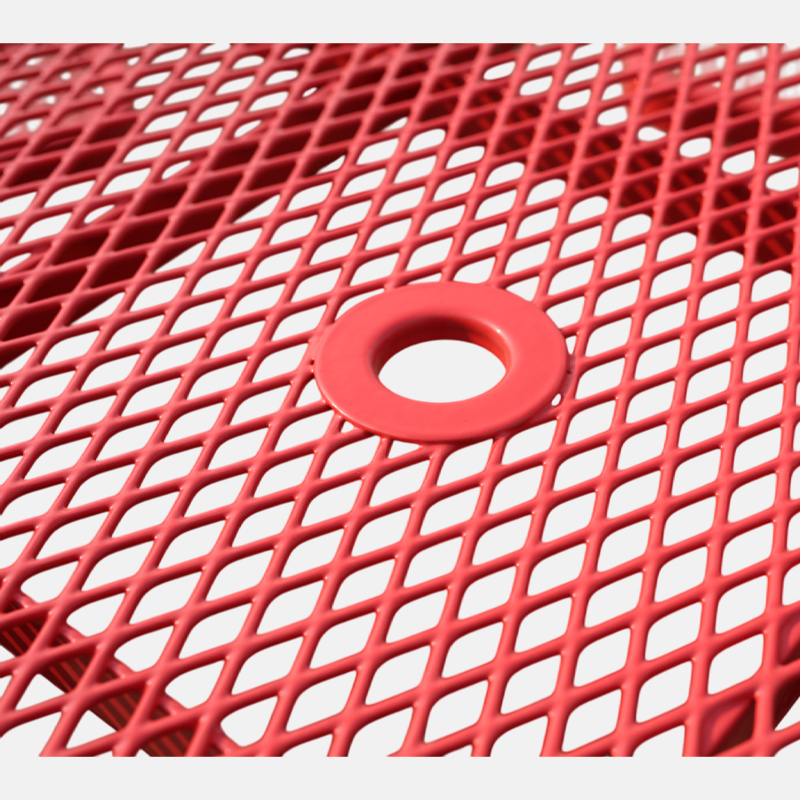
Expanded metal is slit and stretched into a diamond pattern with openings of roughly 3/4 in. Punched steel is a plate with circular holes of around 1/2 in. Both are supplied at 2.5–3.0 mm and both drain freely. The diamond pattern is the more common choice for picnic tables because the larger openings clear debris faster, while punched steel reads as a tidier, more uniform surface on a formal site. Tell us which one your specification names and we build to it.
Is the table suitable for coastal, snowy or high-UV sites?
Yes. The steel core is galvanised and the thermoplastic seals it, so salt air, wet winters and strong sun are exactly what the finish was chosen for. The table is rated from -30 °F to 120 °F, snow brushes off the mesh, and there is no timber to rot. On a coastal or lakeside site, hosing the table down occasionally to remove salt film is worthwhile. Confirm the frame colour you want when you order — black powder coat is the standard.
Can it be matched to the other furniture on the same site?
Yes. Arlau also produces benches, litter bins, planters, bollards, bike racks and tree grates, and the same thermoplastic and powder coat colours run across them, so a heavy duty picnic table, a bench and a bin can read as one scheme. Send the list of items for the park or plaza and we will confirm which of them can be produced in the same finish, on the same schedule.